Online in
Multiple Canadian Provinces
Alberta, British Columbia, Manitoba, Newfoundland And Labrador, Ontario, Saskatchewan
(Online Only)
When everything looks right but something still feels off, somatic, trauma-focused therapy is where the work begins.
You already recognize the pattern. Understanding it hasn't closed the gap between knowing and feeling, because the real shift happens in the body, not the story.
Maybe you've done therapy already, and you still don't have what you came for: the ability to make a decision without arguing with yourself, to feel present in your own life, to sleep without your mind still running.
What this supports, over time, is a slow and gentle return to aliveness.
Client Focus
Session Format: Individual sessions.
Age Specialty: Adult, Senior, Young Adult
Demographic Expertise: Buddhist, Christian, Hispanic / Latino, LGBTQ+, Men, Native American, Women clients.
Languages: Russian, Ukrainian, Spanish
Treatment Approach
- Art Therapy Uses creative activities like drawing, painting, or sculpture as a way to express emotions. It is especially helpful when words are hard to find.
- Contemplative Psychotherapy Combines mindfulness and meditation practices with modern psychology. It encourages awareness and compassion as part of the healing process.
- Existential / Humanistic Therapy Encourages people to explore meaning, freedom, and authenticity in their lives. It focuses on personal growth and living in alignment with one’s values.
- Experiential Therapy Involves hands-on activities to bring emotions into the present moment. It helps clients process feelings more deeply than through conversation alone.
- Integrative Therapy Combines techniques from multiple approaches into a customized plan. It adapts to each client’s unique situation and needs.
- Relational Psychotherapy Emphasizes the healing power of the therapist-client relationship. It uses trust and safety as a foundation for change.
- Somatic Therapy Helps clients notice how emotions are stored in the body. It uses breath, movement, and awareness for healing trauma and stress.
- Transpersonal Therapy Integrates spirituality and higher states of consciousness with psychology. It encourages growth beyond the individual self.
Approach Description: My work brings together somatic psychotherapy, expressive arts, and NARM into one integrated, body-centered approach. In practice, this means we pay close attention to what is happening in your body during session, not just what you are thinking or saying. We might use breath, movement, drawing, or imagery alongside conversation. The creative and somatic elements are not add-ons. They are how we access what talk alone has not been able to reach. This approach is also deeply informed by years of spiritual practice, ceremony, and land-based traditions that taught me to trust the body's own intelligence and timing.
Fees & Insurance
Fees
- Average Session Fee 190
- Affordable sliding scale therapy: apply if you may be eligible.
- I offer sliding scale to clients in need, single caretakers, minors and other. Please Inquire.
- Accepts Insurance
- As a pre-licensed psychotherapist practicing under clinical supervision I can issue receipts that are honoured by majority of benefit plans.
Education & Credentials
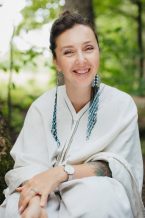
Mariya Garnet Registered Psychotherapist ( Qualifying)
- Female
- License # Ontario / 006027 Terri Robertson ( clinical supervisor)
- Licensed in On
- Practicing Since 2010
Education: - Expressive Arts Therapy, Grad.2026
The CREATE Institute (Canada)
- Applied Psychotherapy, Integral Neuroprogramming
Institute of Advanced Psychotechnologies (Russia)
- Ongoing apprenticeship within Peruvian Vegetalismo tradition
Peruvian Amazon Since 2009
Mariya Garnet Practice Details
Therapy Sessions
- Available Online for residents of Multiple Canadian Provinces Alberta, British Columbia, Manitoba, Newfoundland And Labrador, Ontario, Saskatchewan
- Online Therapy Details: I offer therapy on secure platform.
I work with the body, not just the story. Using somatic psychotherapy, expressive arts, and NARM, I help you notice what your nervous system is holding and begin to shift it. We use breath, sensation, movement, and creative expression alongside conversation. Healing from complex trauma isn't about trying harder. It's about being met differently.