
We Are Built to Connect
What if healing didn’t begin in isolation—but in relationship?
Interpersonal Neurobiology (IPNB), a multidisciplinary framework developed by Dr. Daniel Siegel, reveals that healing is not just a solo journey. It’s a relational process, deeply rooted in the very architecture of the brain.
Neuroscientist Louis Cozolino describes the brain as a “social organ of adaptation,” designed to thrive in the context of safe, attuned connection (Cozolino, 2014). In essence, relationships don’t just influence us—they shape our brains and build our capacity for resilience.
What Is Interpersonal Neurobiology?
IPNB blends neuroscience, psychology, systems theory, and attachment research to explore the interconnected nature of the mind, brain, and relationships (Siegel, 2012). It proposes that:
- The mind is both embodied and relational.
- Our neural wiring is sculpted through emotional and social experiences.
- Relationships are not just the backdrop of our lives—they are agents of healing and transformation.
When we feel seen and understood, especially by those we trust, our nervous systems begin to settle. We gain access to self-awareness, compassion, and the potential for profound personal growth.
The Brain Remembers Relationships
Memory plays a central role in shaping how we connect with others. IPNB distinguishes between:
- Explicit memory: conscious recall of facts and events.
- Implicit memory: unconscious emotional and bodily memories formed through early experiences.
Implicit memory guides our relational patterns, often beneath our awareness. A person who experienced emotional neglect as a child may unknowingly expect rejection in adult relationships. Trauma intensifies this effect, disrupting the brain’s ability to integrate memory and leaving behind fragments that surface as overwhelming emotions, tension, or relational avoidance (Cozolino, 2014).
Neuroplasticity: The Brain Can Change
Fortunately, the brain is adaptable. IPNB emphasizes neuroplasticity—the brain’s ability to reorganize in response to experience. Supportive relationships can rewire neural pathways associated with safety, empathy, and regulation.
Even more compelling is the role of epigenetics. Our social environment, particularly emotionally attuned relationships, can influence which genes are expressed, altering our stress response and long-term mental health (Cozolino, 2014).
The Right Brain Knows the Way
The brain’s right hemisphere plays a leading role in emotional regulation, nonverbal communication, and attachment. According to Allan Schore (2019), the right brain is dominant in processing emotional cues, like facial expression, eye contact, and tone of voice.
This makes right-brain-to-right-brain communication essential for healing, especially in therapy. These nonverbal exchanges foster empathy, trust, and safety, which are critical elements for trauma recovery.
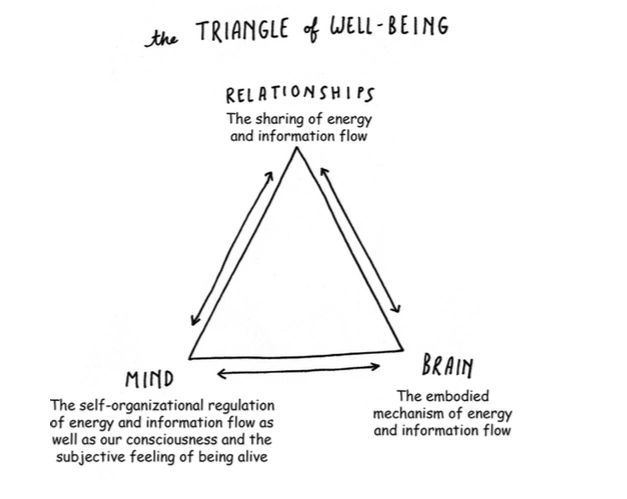
The Triangle of Well-Being
Siegel (2012) describes a model known as the Triangle of Well-Being, where:
- The mind (subjective experience),
- The brain (neural function), and
- Relationships (interpersonal exchanges)
are all interconnected. A change in one influences the others. Safe, nurturing relationships help regulate the brain, which supports a more integrated mind—allowing individuals to feel more whole, resilient, and present.
Integration of Implicit Memory
Trauma often disrupts integration, storing memories as bodily sensations or fragmented emotions. This is why someone may react strongly to a seemingly benign situation—because the body remembers what the mind cannot articulate.
Therapy can support the integration of these memories through:
- Mindfulness and somatic awareness
- Narrative work that links past and present
- Relational safety, where clients can explore emotional experiences without judgment (Badenoch, 2008)
As these pieces come together, individuals gain clarity, emotional regulation, and the ability to reframe their relational patterns.
Rupture and Repair: The Heart of Relational Resilience
Disconnection is inevitable in any relationship—but so is the opportunity for repair.
Research by Ed Tronick, supported by Schore’s work (2019), shows that moments of rupture followed by repair are essential for building trust and resilience. In therapy, the act of naming and repairing misattunements becomes a blueprint for healing—teaching clients that relationships can survive conflict and deepen through vulnerability.
The Therapist as Co-Regulator
In IPNB-informed therapy, the therapist doesn’t just interpret—they regulate. Through body language, tone, and presence, the therapist becomes a secure base (Bowlby, 1988), providing a relational anchor for the client’s nervous system.
Schore (2019) calls this interbrain synchronization—a dynamic, nonverbal exchange that supports emotional repair. Over time, clients internalize this steady presence, developing their own capacity for self-regulation and resilience.
Integration: The Core of Mental Health
According to Siegel (2012), integration—linking differentiated parts of the self—is the essence of mental well-being. When integration is present, we experience:
- Flexibility
- Emotional stability
- A coherent sense of self
Therapy fosters this by helping individuals reconnect with their thoughts, emotions, sensations, and relationships in an integrated way. This allows them to navigate life’s challenges with more clarity, calm, and connection.
Final Thoughts: Healing Is a Shared Journey
IPNB offers more than theory—it offers hope. It reminds us that healing is not just a mental process, but a relational one. We are wired to connect, and within safe relationships, our brains can change. Old wounds can integrate. Resilience can grow.
In a world that often isolates and disconnects, IPNB is a powerful reminder: healing doesn’t happen alone. It happens in relationship.
References
Badenoch, B. (2008). Being a brain-wise therapist: A practical guide to interpersonal neurobiology. W. W. Norton & Company.
Bowlby, J. (1988). A secure base: Parent-child attachment and healthy human development. Basic Books.
Cozolino, L. (2014). The neuroscience of human relationships: Attachment and the developing social brain (2nd ed.). W. W. Norton & Company.
Schore, A. N. (2019). The development of the unconscious mind. W. W. Norton & Company.
Siegel, D. J. (2012). The developing mind: How relationships and the brain interact to shape who we are (2nd ed.). The Guilford Press.